The Tradeoffs You Refuse to See
Unlimited PTO sounds like a benefit.
No accruals. No limits. Take what you need.
Freedom (on paper).
And yet, something strange happens.
People take less time off.
Unlimited PTO → When Freedom Becomes Friction
The logic behind unlimited PTO is clean.
- Redefine the constraint, and people will self-regulate.
- Trust replaces policy.
- Flexibility replaces structure.
- Responsibility shifts. (Quietly)
It feels like progress.
But once you’re inside it, the experience shifts.
There’s no number to aim for. No baseline to measure against.
No clear signal of what’s “normal.”
So instead of freedom, something else emerges.
Hesitation.
You start to ask questions that never existed before:
- Is this too much time?
- Is anyone else taking this much?
- What does this signal about me?
And without realizing it, the decision stops being about rest… and starts being about perception.
What looked like a benefit quietly becomes a burden.
Not because the policy is flawed, but because the responsibility has moved.
From the company… to the individual.
Nothing was removed.
The constraint didn’t disappear.
It just changed form.
From a defined amount of time…
to hesitation.
This isn’t just a workplace quirk.
Incentives and constraints are the mechanisms that shape behavior inside a system.
When a system is tuned, those are the elements that change. They don’t disappear.
They get redefined, or redistributed.
👉 That’s the tradeoff.
Next Day Delivery → When Speed Shifts Decision
If Unlimited PTO shifts responsibility quietly, Amazon makes the shift visible.
The promise is simple:
- Get what you want.
- Tomorrow.
Sometimes today.
It feels like progress.
Faster delivery. Less waiting. More convenience.
And it works.
- We buy more.
- We click faster.
- We hesitate less.
But speed changes behavior.
When something arrives tomorrow, there’s less pressure to reconsider today.
So we order more options. Multiple sizes. Multiple colors. Just to see.
What used to be a decision, becomes a temporary holding pattern.
Buy now. → Decide later.
And when “later” arrives, return becomes part of the experience.
➖
The system didn’t just make delivery faster.
It made deciding easier to control.
Not by delaying the decision, but by restoring the feeling of browsing to the shopper.
And the cost of that decision doesn’t disappear. It moves.
It shows up…
🔎 in reverse logistics
🔎 in repackaging and redistribution
🔎 in items that can’t be resold
🔎 in sellers absorbing return costs
🔎 in the physical waste left behind
What feels frictionless on the front end, distributes responsibility to the back end.
👉 Multiple unseen tradeoffs emerge.
It’s easy to see this in shipping and returns.
What gets easier up front… doesn’t disappear. It moves.
This is how tradeoffs behave.
When friction is removed in one place, it doesn’t simply vanish. It relocates.
And this same pattern shows up in places where the stakes are much higher.
Healthcare → When Efficiency Becomes Risk
In healthcare, optimization doesn’t look like faster shipping.
It looks like efficiency.
- More patients seen.
- Shorter wait times.
- Tighter schedules.
- Better utilization of staff and facilities.
On paper, it’s exactly what you’d want.
- Less idle time.
- More access.
- A system that moves.
And in many ways, it works.
Until you’re inside it.
The visits feel shorter. More transactional.
- Eyes move between you and a screen.
- Questions become more structured.
- Less space for nuance. Less space for context.
Nothing is obviously broken.
But something feels… thinner. Less held.
➖
Efficiency didn’t remove pressure.
It concentrated it.
- Into smaller windows of time.
- Into more decisions per hour.
- Into less margin for error.
And the tradeoffs show up in ways that are harder to measure:
🔎 missed context
🔎 subtle misdiagnoses
🔎 delayed recognition of complications
🔎 clinician fatigue and cognitive overload
🔎 patient disengagement and apathy
The system becomes more efficient… while becoming more fragile.
In healthcare, the tradeoffs show up in people.
But sometimes, tradeoffs don’t show up right away at all.
Plastics → When Convenience Compounds
Plastics didn’t arrive as a problem.
They arrived as a breakthrough.
- Lighter than glass.
- Cheaper than metal.
- Moldable into almost anything.
They made products more accessible. Packaging more efficient. Distribution easier.
It felt like pure progress.
And like every optimization we’ve seen, it worked.
- Costs dropped.
- Production scaled.
- Availability expanded.
- Variety increased.
Plastic became the default — not because it was perfect, but because it was good enough and cheap enough everywhere.
➖
The tradeoffs didn’t show up immediately.
It wasn’t in the product. It wasn’t in the moment of use.
It showed up later.
- After disposal.
- After distribution.
- After scale.
Waste didn’t disappear. It accumulated.
🔎 In landfills.
🔎 In oceans.
In places we don’t directly see.
And eventually… in places we can’t ignore.
🔎 Inside ecosystems.
🔎 Inside food chains.
🔎 Inside the human body.
➖
Recycling was positioned as the solution.
And for a while, that felt like progress too.
- But the economics haven’t yet fully worked.
- The infrastructure has never fully scaled.
- And the volume keeps growing.
So the system continues — producing, consuming, discarding — with the consequences pushed further out of view (but still compounding).
➖
And once this model takes hold, it doesn’t stay still.
➡️ It gets faster.
➡️ Cheaper.
➡️ More compressed.
What began as efficiency becomes acceleration.
- New entrants seeking to capitalize (Temu, SHEIN, etc.).
- More products.
- Shorter lifespans.
- Higher turnover.
The system doesn’t just sustain itself. It amplifies.
➖
Some tradeoffs show up quickly.
Some take time.
And some are so well hidden, we don’t recognize them until they’ve already reshaped everything.
AI → When Help Replaces Formation
A 10-year-old gets an assignment.
“Write anything.”
No constraints. No rules. Just create something original.
So the student opens a school app, finds their way to a new button — “AI Mode” — and tries it.
Why wouldn’t they?
A few prompts later, they have three pages.
Structured. Coherent. Impressive.
The student stands up in front of the school and reads it aloud.
Proud.
Until the words start catching.
Vocabulary they don’t quite recognize. Sentences they can’t quite carry.
The performance holds — but the understanding doesn’t.
➖
The student didn’t break the system.
They followed it.
The tool was there.
No one said not to use it.
The goal was to produce something good.
So they did.
Exactly as the system was designed.
And that’s the shift.
AI makes it easier to produce the output.
- Faster writing.
- Cleaner structure.
- Better phrasing.
But something else moves.
The struggle disappears.
The friction of finding the word. The pause to think through the idea. The slow shaping of a sentence into meaning.
All the things that feel inefficient… but are actually doing the work of building capability.
The Pattern, Fully Revealed
🤔 If AI makes thinking easier, → what happens to learning?
🤔 If expression becomes instant, → what happens to understanding?
🤔 If we can produce without effort, → what exactly are we becoming good at?
The tradeoffs are rarely obvious.
➡️ Because the output improves.
➡️ The system appears to advance.
But underneath, something quieter is happening.
The work that used to build skill is being done somewhere else.
Or not at all.
We’ve seen this before: Systems that made things cheaper… and quietly made the consequences more expensive.
Not immediately. Not obviously.
But eventually.
We can say with certainty that some systems are easier to question than others. These are systems where the tradeoffs are easier to see.
And others where the tradeoffs are harder to question.
Elections, for example, are framed as choice.
Participation feels like agency.
A vote. A voice.
But the structure surrounding that choice —
- how options are formed,
- how incentives are shaped,
- how outcomes are measured and messaged —
… quietly defines what’s actually possible.
Choice doesn’t remove constraint. It narrows it.
And redistributes it — upstream and downstream — into places we don’t directly see…
- making outcomes harder to trace,
- and easier to resolve into story after the fact.
Nothing here is accidental.
It’s how systems evolve.
When a system naturally adapts or is tuned, incentives and constraints don’t disappear.
☝️ They’re redefined.
☝️ Redistributed.
👉 That’s the tradeoff.
The surprising fact to hang with
Most of the time, it’s not that we refuse to see tradeoffs, it’s that we are never shown where to look, whether due to misdirection or because first-order effects are emphasized.
The unmistakable fact is that tradeoffs don’t disappear.
They move.
Across people. Across systems. Across time.
And sometimes… into us.
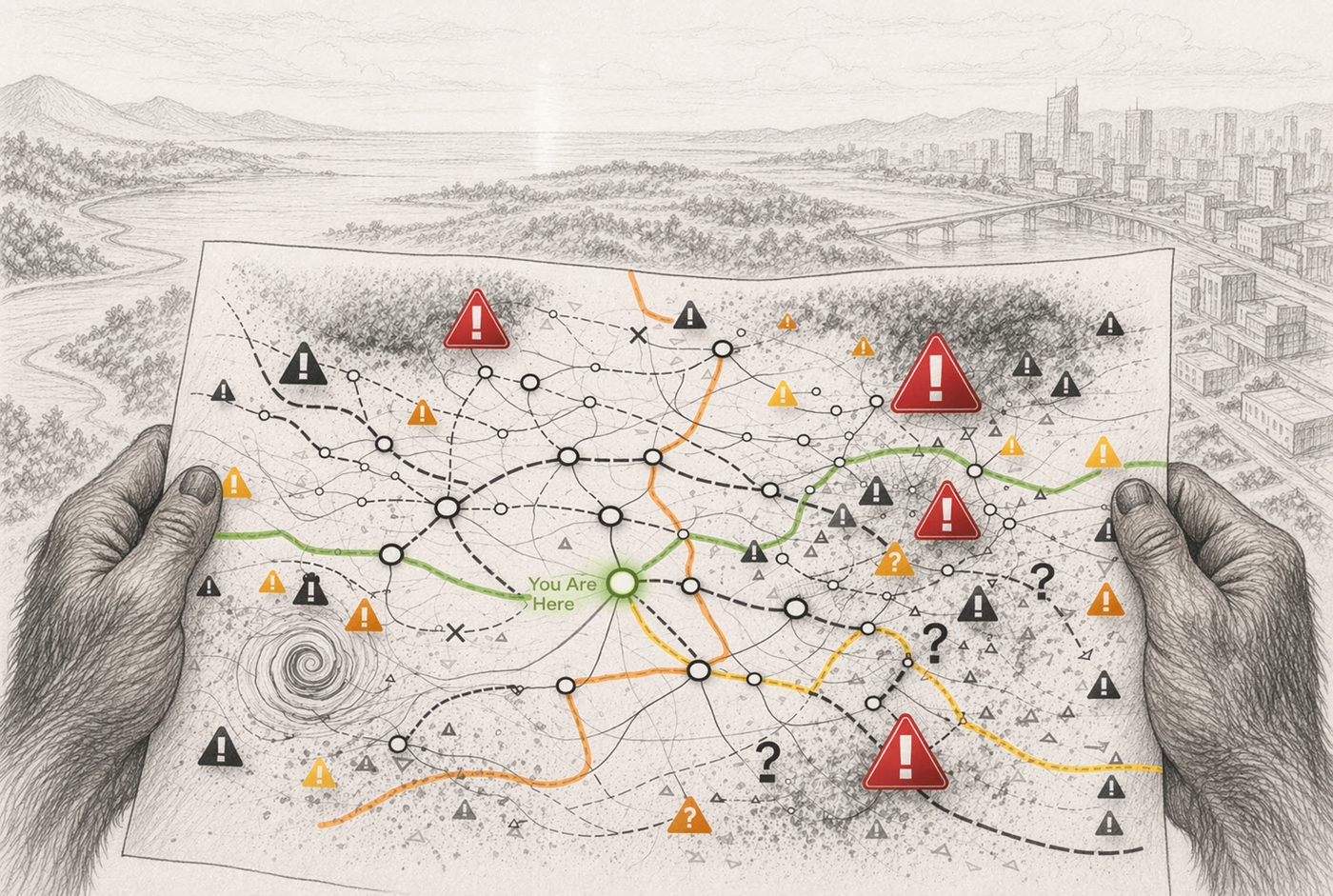
The tradeoffs we refuse to see don’t simply go away.
They just wait — until they show up somewhere we didn’t think to look.
Continue the publishing sequence
Seeing the tradeoffs doesn’t remove them. It clarifies where you choose to stand.