An early system
Most of us understood systems before we knew the word.
Take musical chairs.
The rules are simple: music plays, players move, chairs are limited, and when the music stops everyone tries to sit.
The one left standing is removed from the game.
A chair is removed. Play continues until one chair and one sitter remains.
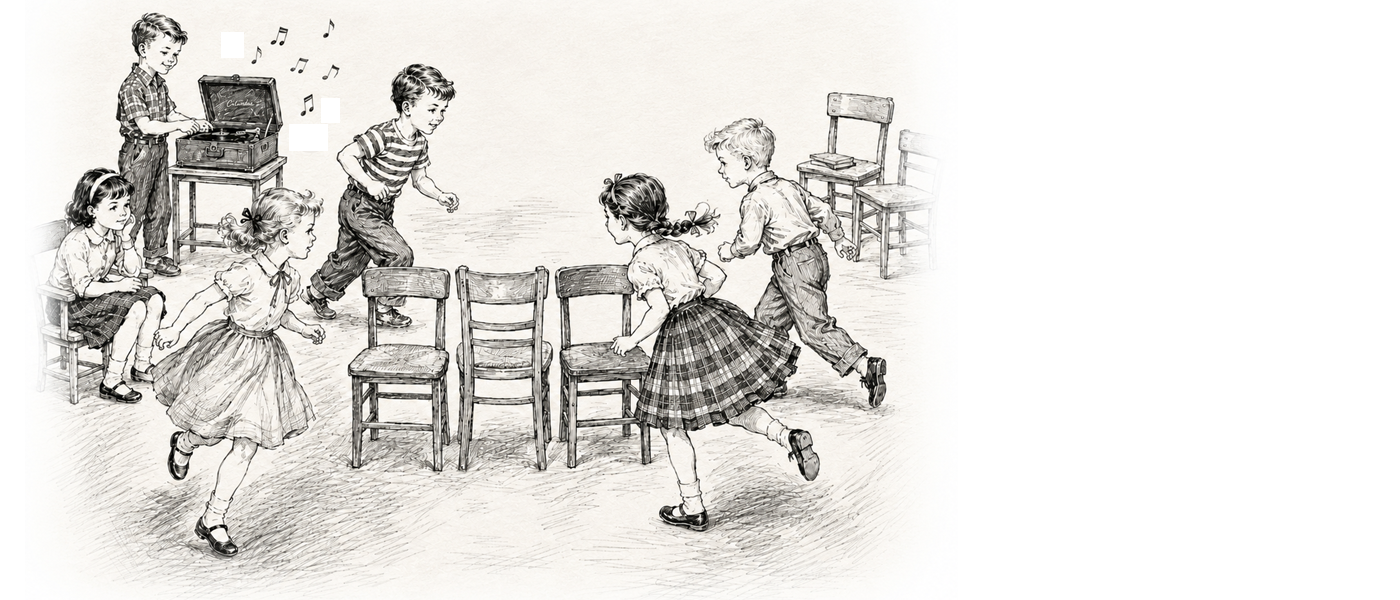
It feels like a game of timing, speed, and luck.
But it is also a system.
The missing chair matters. The music matters. The rules matter. The other players matter. The threat of elimination matters.
Change any of those, and the behavior changes.
The game is not evil. The players are not foolish. The person left standing is not defective.
The outcome is designed into the structure.
Musical chairs is not just a game. It is a simple system for producing predictable behavior under artificial scarcity.
A system does not need to be complex to shape behavior. It only needs rules, signals, constraints, participants, and consequences.
Once you see the system in the game, you can start seeing similar patterns elsewhere: in work, relationships, markets, platforms, policies, metrics, and everyday choices.
The same structure shows up in less obvious systems: hiring, budget cycles, dashboards, performance reviews, customer queues, pricing models, advertising, and workplace policies — along with almost anything else you can think to name, and many things you might not yet think of as systems.
The setting changes. The pattern remains.
- Rules create constraints.
- Signals shape timing.
- Scarcity changes behavior.
- Rewards change what feels worth doing.
And outcomes begin to feel personal even when the system helped produce them.
Musical chairs is simple enough to see this clearly.
That is why it matters.
Once you see how a simple game can shape behavior, it becomes harder not to ask what the larger systems around us are teaching too.
This is the beginning of MNKY Math.
Because when a system produces something, it does not only produce the visible output. It also produces habits, expectations, shortcuts, tolerances, tradeoffs, trust patterns, compliance patterns, and assumptions about what is acceptable to sacrifice.
So the “thing produced” is never only the thing.
Continue to Why MNKY Math to understand why this lens exists.
Other useful paths:
To learn how to wander without getting lost, visit The MNKY Math Garden.
To see what drives this work — and what MNKY Math hopes it helps produce — visit What Drives Us.