
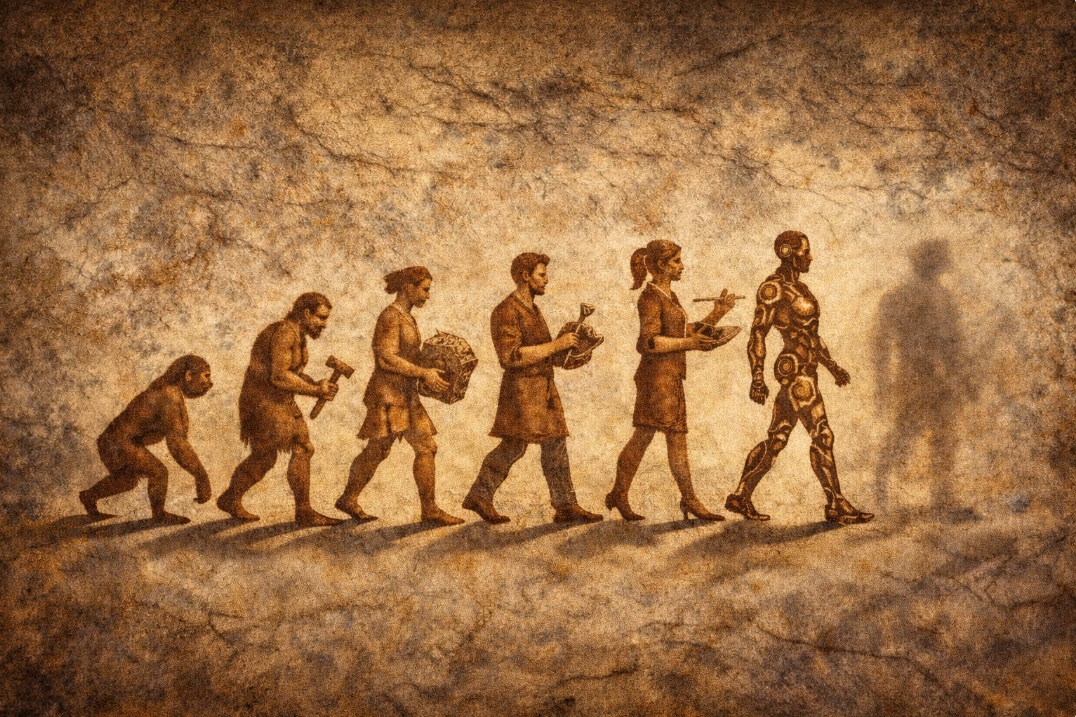
Iterative Math: What Version Are You Running
Iteration is everywhere.
Software evolves through releases and updates. Version numbers change. Features appear, disappear, and improve.
Automobiles do something similar. A new model year arrives. Sometimes the changes are cosmetic. Sometimes an entire platform is redesigned.
Brands iterate as well. Messaging shifts. Logos evolve. What once resonated eventually becomes dated and gets replaced.
Even places iterate. Restaurants revise menus. Neighborhoods redevelop. Language itself evolves as words take on new meanings over time.
Iteration is expected in these systems. Improvement rarely arrives all at once. It emerges through cycles of testing, adjustment, and release.
We are surrounded by systems that continuously update themselves.
But there is one system we rarely think about in these terms.
… Ourselves.
Humans Run Versions Too
Human lives also move through versions.
In early years, the metrics guiding behavior tend to be simple and visible.
Grades.
Friendships.
Participation in teams or activities.
Approval from parents and teachers.
In this sense, a ‘metric’ does not have to be a number. It can be any signal of the forces shaping behavior in a moment — approval, belonging, achievement, responsibility, or progress. These signals act as operating metrics. They shape behavior and reinforce what counts as success.
As independence increases, the surrounding systems begin to change.
New metrics appear.
- Education decisions.
- Career progression.
- Financial independence.
- Relationships.
Later still, the signals shift again.
- Family responsibilities.
- Stability.
- Contribution.
- Legacy.
Each stage installs new expectations and priorities. The operating environment changes, forces modulate, and behavior adapts accordingly.
Unlike software, however, these updates rarely arrive with a notification.
No alert appears announcing that a new version has been installed.
Most of the time the transition happens gradually.
→ A role evolves.
→ Responsibilities tune.
→ Identity shifts.
And before long, the version you’re running has quietly evolved from where you began.
Versions Operate in Modes
Versions also operate in different modes.
Software systems move through recognizable phases: development, expansion, maintenance, and eventually retirement.
Human lives show similar patterns.
Sometimes the dominant mode is exploration — trying new paths and widening the field of possibility.
Sometimes it is growth — building capability, expanding responsibility, and gaining momentum.
Sometimes the priority becomes maintenance — stabilizing what has already been built and protecting it from unnecessary disruption.
At other moments, people enter disruption mode — deliberately breaking existing patterns to change direction.
And sometimes the system itself is shifting, placing someone in transition between versions.
These categories are not fixed definitions. They are examples.
Most lives contain elements of several modes at once. A career may be in growth mode while family life operates in maintenance mode. Identity may be in transition while professional responsibilities continue steadily forward.
Modes overlap. Hybrid states are common.
What matters is not which mode someone occupies.
What matters is recognizing the modes you are in.
Version Awareness
At this point a natural question emerges:
Why does any of this matter?
Because most people are responding to the signals around them without realizing that those signals are shaping the version they are running.
The metrics surrounding each stage influence priorities and behavior.
Achievement may dominate early years.
Performance and progress often define the middle stages.
Responsibility and contribution tend to appear later.
These signals rarely operate in isolation. They exist inside systems we occupy — schools, workplaces, communities, families, routines, solitude, reflection, inner dialogue — each carrying its own expectations.
Over time those signals help determine how the current version of a person operates.
Most of the time this happens quietly. People focus on goals, responsibilities, and daily demands. They respond to the environment around them.
The version running in the background rarely becomes the subject of attention.
Version Authorship
Another way to think about this is through the idea of authorship.
Our versions are not always deliberately written. Many are installed gradually by the systems and experiences surrounding us.
Version authorship tends to fall along a spectrum.
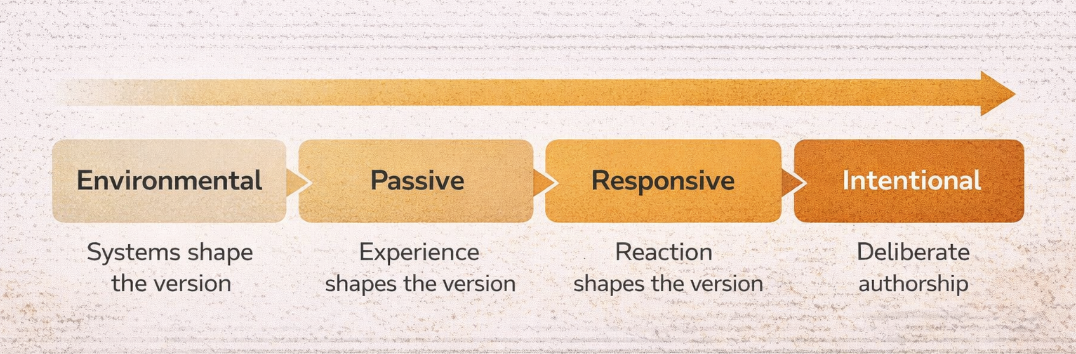

Most versions of ourselves begin toward the left side of this spectrum.
- Schools install expectations.
- Workplaces introduce performance metrics.
- Communities reinforce norms and priorities.
Simply participating in these systems shapes the version running at any given time. Being present in an environment influences behavior, even when no deliberate choice was made.
Only occasionally do people pause and consciously author the next version.
The context to hang with
Awareness of version does not force change.
→ Awareness provides context. → It clarifies which metrics are currently driving behavior. → It reveals whether the mode you are operating in matches the direction you want to move.
And sometimes it opens the possibility of writing the next version more intentionally.
The mathematics of intentional iteration is simple:
Systems update through cycles of observation, adjustment, and release.
Our lives follow a similar pattern.
Most people know what version of their phone they are running. Far fewer pause to ask what version of themselves they are running. Iteration begins with observation.
A single question can begin the next iteration.
What version are you running?
Continue the publishing sequence
What gets counted shapes behavior. This explores how metrics influence choices — and what happens when counting begins to define you.