
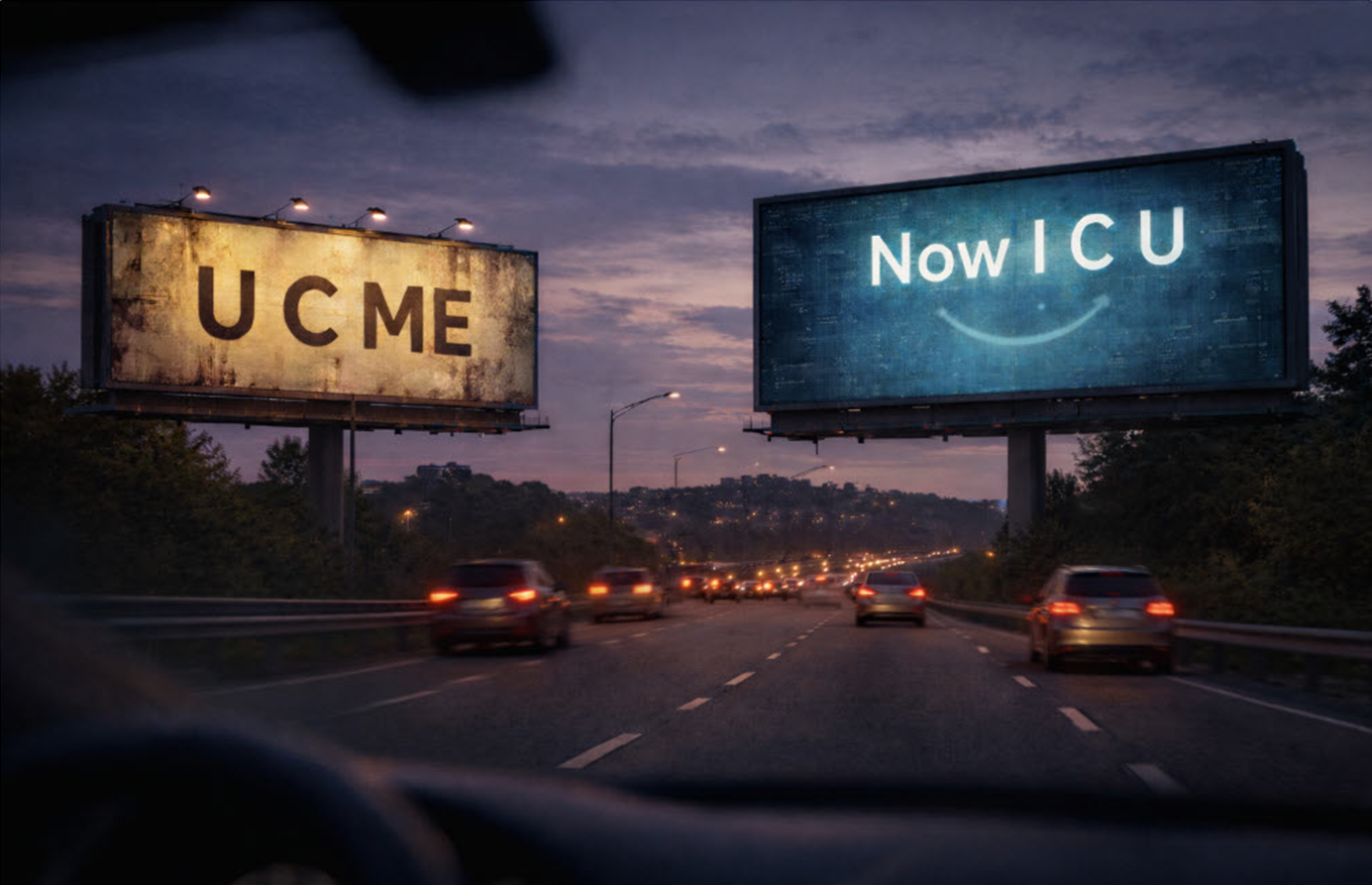
How Attention Math Follows Us into Public Space
When Billboards Learned to Measure You
Most of us don’t really notice billboards anymore.
They’re part of the background. A familiar fixture of highways and city streets. You pass them. They pass you. Occasionally one catches your eye, but mostly they fade into the scenery.
For decades, that relationship was simple.
- You looked at them.
- They didn’t look back.
A Familiar Surface
Traditional billboards were built for visibility, not awareness.
Visibility meant being seen.
Big letters. Bright colors. A message designed to be seen at speed. Their success was inferred, not known. If traffic flowed and sales later rose, the billboard got some of the credit. If not, it quietly stood in place, doing what it always had.
The logic was one-directional:
You see me.
Nothing about that exchange felt personal. Or precise. Or invasive. It was just broadcast infrastructure. Awareness, in today’s sense, didn’t exist yet.
Two-directional visibility wasn’t technically feasible.
A Quiet Inversion
Somewhere along the way, that relationship flipped. Not all at once. And not in a way most of us consciously noticed.
Billboards went digital. Pixels replaced paper and ink. Sensors appeared. Software followed. And with these shifts came a subtle change in posture.
The message on the board was no longer just about being seen.
It became about seeing.
What the Billboard Can Sense
Modern digital billboards don’t just display content.
They listen.
As phones pass by, they emit Wi-Fi and Bluetooth signals; small, constant pings most of us never think about. Those signals can be detected, matched, and grouped. Not by name. Not by face. But by unique, anonymized identifiers tied to the device.
From those signals, systems can infer:
- how many people passed by
- how long they lingered
- which direction they were traveling
- which screens they were likely exposed to
- and whether they returned later
In other words, the billboard doesn’t just know that you and others passed.
It often knows which ad you likely saw, and how often. Most people don’t realize this until someone tells them. And once you see it, it’s hard to unsee.
I sense you.
That realization catches many people off guard.
When Awareness Changes Direction
This is the moment most people miss. Not because it’s hidden, but because we don’t expect it to be there.
The transformation isn’t about brighter screens or better ads. It’s about awareness changing direction.
- The old model assumed attention was given.
- The new model assumes attention can be inferred.
And when attention becomes something that can be measured, priced, and optimized, the meaning of “being seen” quietly changes.
Not all at once. Not obviously.
But permanently.
More Than Meets the Eye
From the outside, a digital billboard still looks like a billboard.
- Same placement.
- Same purpose.
- Same passing glance.
But beneath the surface, something else is happening.
Public space is no longer just a stage. It is becoming something that notices and records.
And attention — once abstract and unknowable — is now treated as something legible. Countable… and actionable.
Whether or not that assumption holds true is a question worth sitting with.
Two thoughts to hang with
What changes when attention is no longer assumed, but measured?
And how differently do we move through public space once we realize the environment is paying attention back?
Continue the publishing sequence
By now you should be seeing how we touch many systems throughout our day. This is why MNKY Math exists to offer orientation — not answers — inside those systems.